You can’t make it up
LONDON — The Church of England has been forced to withdraw an interfaith award presented on the 25th anniversary of the 9/11 attacks to a Pakistani cleric who once pledged to bestow the honorary title “Sword of God” on Osama bin Laden, in what critics are calling a catastrophic failure of judgment at the highest level of the established church.
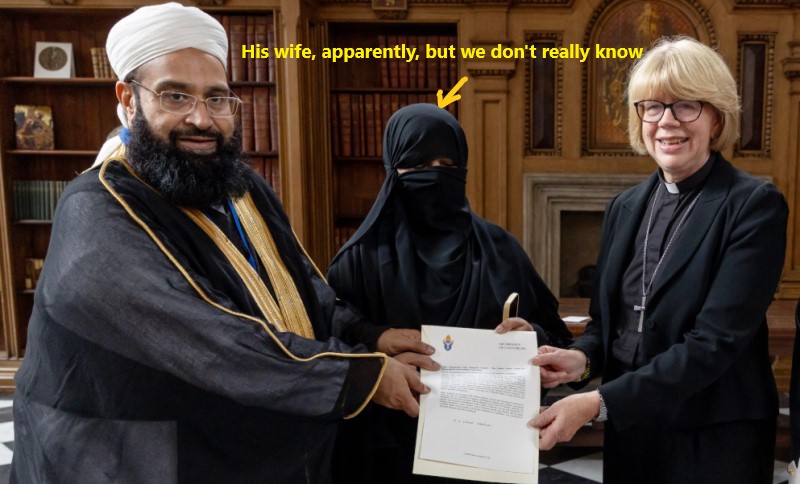
Dame Sarah Mullally, the first female Archbishop of Canterbury, presented the Hubert Walter Award for Reconciliation and Interfaith Cooperation to Hafiz Muhammad Tahir Mehmood Ashrafi, chairman of the Pakistan Ulema Council, at Lambeth Palace on Friday 11 September — the very day the world marked 25 years since nearly 3,000 people, including 67 British citizens, were killed in the terrorist attacks on the United States.
The decision drew immediate and furious condemnation after it emerged that in 2007, Ashrafi had described bin Laden as “fighting for Islam against the Russians, Americans and British,” and had pledged to confer upon him the title Saifullah — “Sword of God” — in response to British author Salman Rushdie receiving a knighthood.
The cleric’s record extends well beyond those remarks. He has described suicide bombings in Afghanistan as lawful, supported Pakistan’s Islamic blasphemy laws — which carry the death penalty — and opposed their repeal, as well as child marriage legislation. He has also accused Jews and Christians of conspiring to destroy nuclear-capable Pakistan.
A Week of Backlash
Despite the award being presented on one of the most solemn days in modern British memory, it was not until Thursday that Lambeth Palace confirmed the honour had been withdrawn.
“Previous comments made by Imam Ashrafi have come to light that have led Lambeth Palace to reconsider this award and we can now confirm today that the award has been withdrawn,” the Palace said in a statement. “We have contacted Imam Ashrafi to make him aware of this decision.”
The statement notably continued to affirm the Church’s commitment to interfaith dialogue, and added: “We continue to pray for the Christian community in Pakistan, and for all those working for interfaith dialogue and harmony in Pakistan and around the world.”
That attempt at damage control did little to quiet the storm. Nick Timothy, the Conservative Shadow Justice Secretary, who helped surface the cleric’s past remarks, said: “It’s right that this award — given to an imam who praised Osama Bin Laden for targeting Brits — has been withdrawn. The Archbishop of Canterbury needs to learn now and stop giving succour to those who would destroy us. The progressive dance with Islamism is dangerous and must end.”
The National Secular Society called the original presentation “obscene, and almost beyond parody,” while 9/11 survivors and their families voiced their anger at what they saw as a profound insult to the memory of the dead.
A Pattern, Not a Glitch
A spokesperson for Ashrafi said his 2007 remarks were being reported “without their proper context,” claiming they were not an endorsement of bin Laden but an illustration of the offence caused to Muslims by Rushdie’s honour.
Centre-right commentators, however, argue the episode is not an isolated gaffe but a symptom of a deeper problem: an institutional reluctance within the Church of England to scrutinise the views of interfaith partners, driven by a political culture that equates any criticism of extremism with bigotry. The fact that the award was given on the anniversary of 9/11 — a day when the UK observed a national moment of remembrance — only underscores how far removed the decision was from public sentiment.
The original justification for the award was Ashrafi’s “longstanding support for religious minorities in Pakistan, particularly the Christian community” — a record that stands in stark contrast to his defence of blasphemy laws under which Christians in Pakistan are regularly prosecuted and killed.
As the Church of England grapples with the fallout, one question lingers: how was it that a cleric with this record was vetted, selected, and presented with a prestigious national honour at the very seat of British Christianity — without a single person at Lambeth Palace raising a concern until the public did?