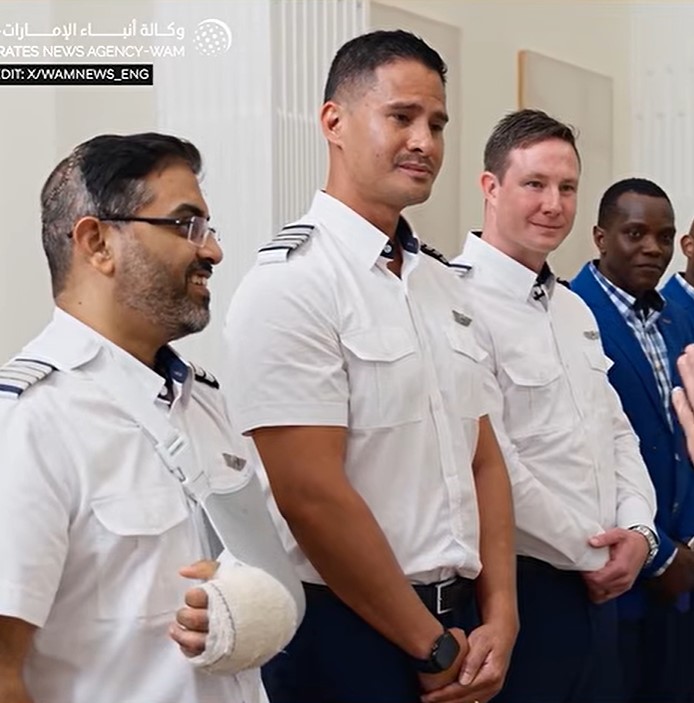
In a ceremony in Abu Dhabi on 27 October, Dubai Crown Prince Sheikh Hamdan bin Mohammed bin Rashid Al Maktoum presented the First Class Order of Zayed II to the flight and cabin crew of flydubai Flight FZ1073. Among those recognised was South African relief pilot Rowan Tooth of Kimberley in the Northern Cape.
UAE President Sheikh Mohamed bin Zayed Al Nahyan conferred the honour for the crew’s actions on 30 September, when a Boeing 737 MAX carrying 174 passengers and eight crew members from Dubai to Tel Aviv faced a life-threatening emergency. UAE authorities have described the incident as a premeditated terrorist attack. The 29-year-old Omani co-pilot attacked the Indian captain, Smit Machchhar, with a cockpit crash axe, intending to seize the aircraft and crash it into Ben Gurion Airport in Israel. Investigators later linked the plot to inspiration drawn from the 11 September 2001 attacks.
Despite serious head injuries, Captain Machchhar managed to unlock the cockpit door before collapsing. Passengers and cabin crew then overpowered and restrained the attacker. With the aircraft in a steep dive that saw it lose roughly 17 000 feet in under a minute, two off-duty relief pilots who were travelling on board entered the flight deck. Tooth and a New Zealand colleague stabilised the jet under extreme conditions, levelled the flight path and executed a safe diversion to Tabuk Airport in Saudi Arabia. All 182 people on board survived.
Tooth was raised in Kimberley, attended Kimberley Junior School and later Pretoria Boys’ High School. He is the son of the late Barry Tooth, a well-known Kimberley sportsman who represented Griqualand West in cricket and was regarded as a local sporting icon. The family’s ties to Northern Cape sport and community life have added a strong local dimension to the international recognition.
The award ceremony also honoured Captain Machchhar, who has received separate international praise, as well as other crew members, including Kenyan cabin crew who assisted in restraining the attacker. UAE leaders emphasised the crew’s professionalism and the priority of protecting human life. International figures, including Indian Prime Minister Narendra Modi and Israeli President Isaac Herzog, have publicly commended the actions that averted catastrophe; Israel has indicated it will present its own civilian heroism award to the captain once he recovers.
For South Africans, the episode underscores the competence and composure of locally trained aviators operating in demanding international environments. Tooth’s background at one of the country’s leading boys’ high schools, combined with the practical skills required to recover a modern airliner in extremis, illustrates the value of rigorous education and professional standards. The safe outcome depended on rapid, coordinated action by multiple people under severe physical and psychological stress.
Details of Tooth’s precise career path beyond his role as a flydubai relief pilot have not been widely reported, and the airline has not issued extensive public comment identifying the off-duty pilots by name. What is clear from official UAE statements and contemporary accounts is that the two relief pilots’ intervention was decisive in restoring controlled flight after the cockpit assault and subsequent plunge.
The incident has prompted broader questions in aviation circles about pilot vetting and cockpit security on sensitive routes. For readers in the Northern Cape and beyond, however, the immediate significance is simpler: a South African pilot from Kimberley stood among the crew whose actions prevented a potential mass-casualty attack, and the United Arab Emirates has formally recognised that contribution with one of its highest national honours.