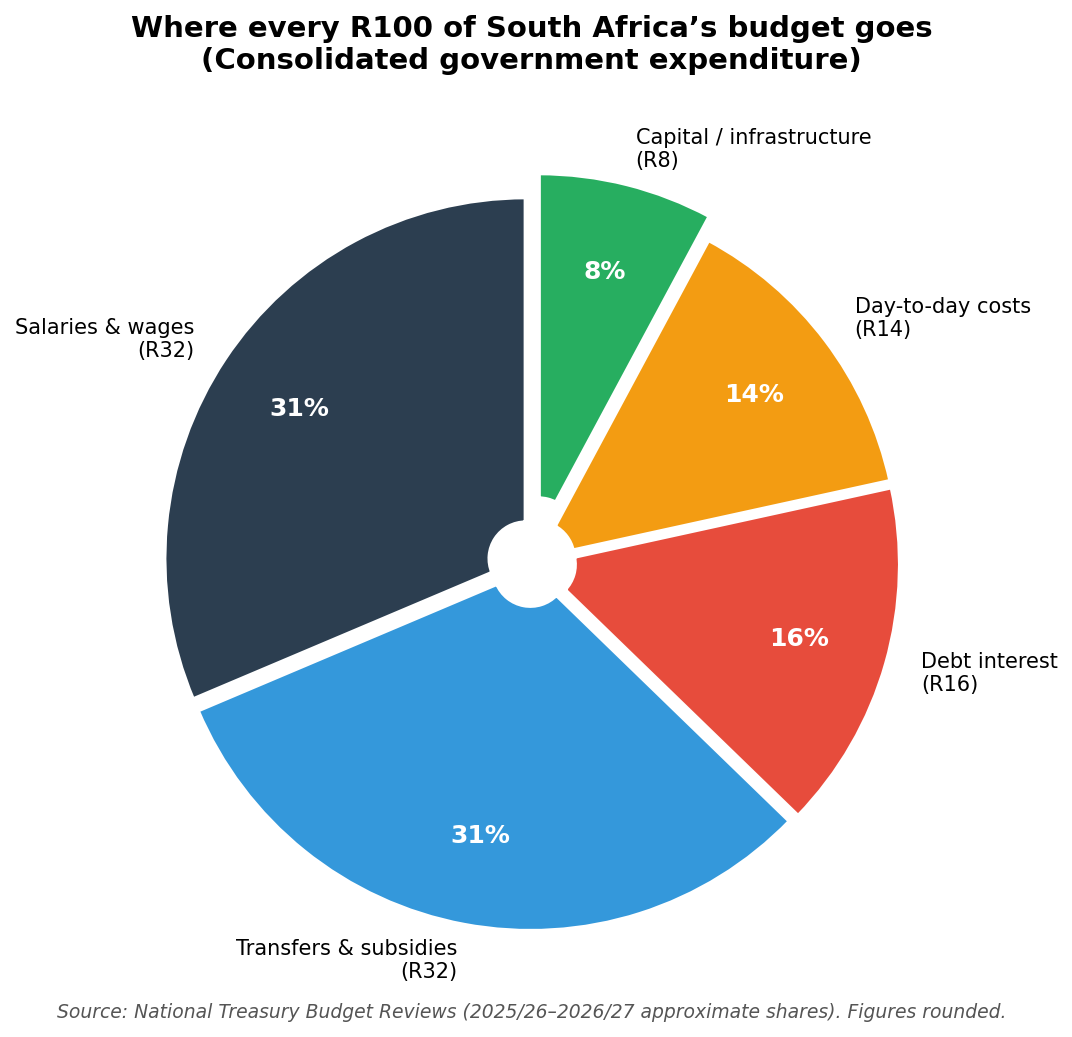
South Africa’s economy is not growing because the national budget is structured against growth. For every R100 the government spends, the bulk goes to salaries, debt interest, day-to-day costs and grants — leaving only a thin slice for the investments that expand the productive base of the economy.
According to recent National Treasury consolidated expenditure figures (around the R2.58–2.67 trillion range for 2025/26 and 2026/27), the rough breakdown is:
- R32 — Compensation of government employees
- R16 — Interest on government debt
- R14 — Goods and services (day-to-day running costs)
- R32 — Transfers and subsidies (social grants, municipalities and other payments)
- R8 — Capital and infrastructure spending
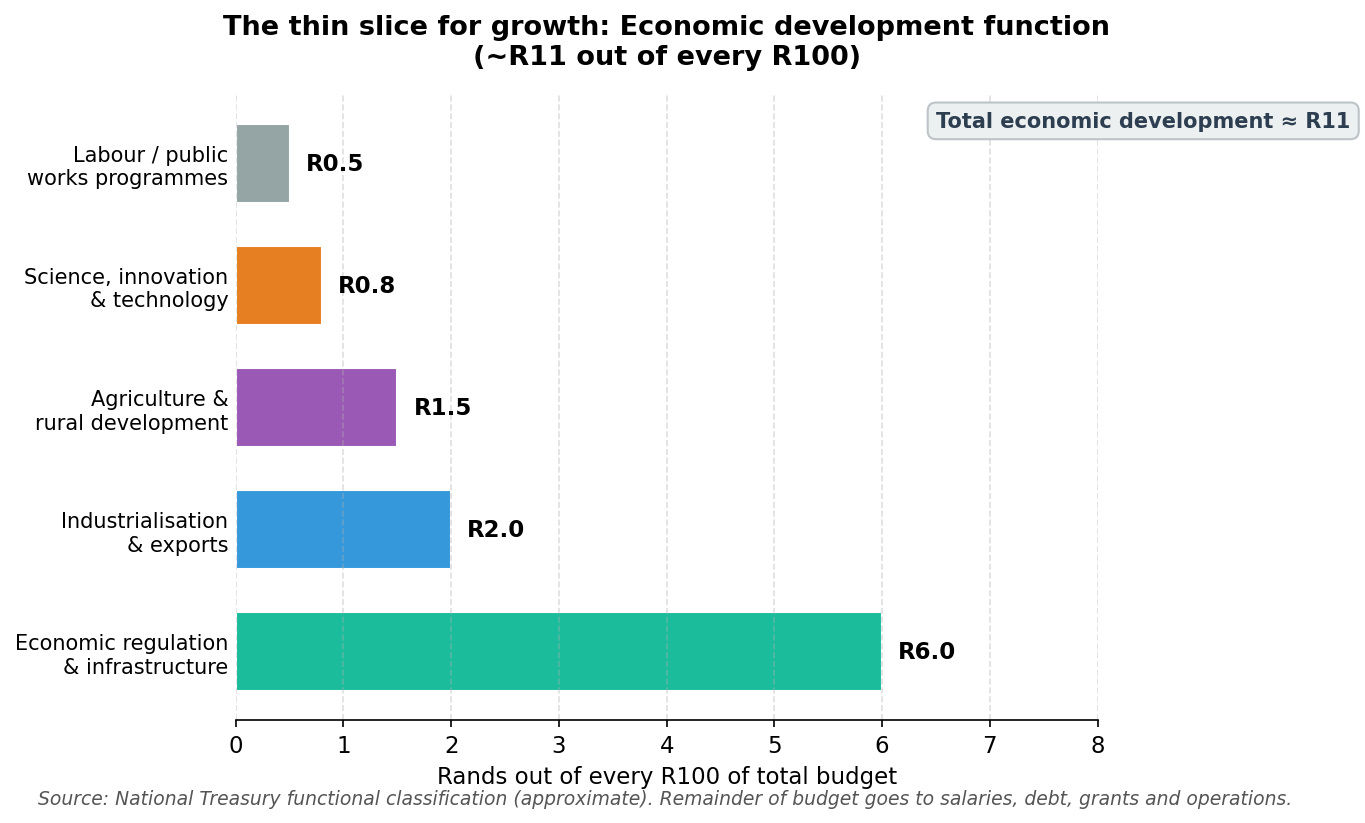
Only about R11 of every R100 is allocated to the entire economic development function. Inside that limited envelope:
- Roughly R6 goes to economic regulation and infrastructure
- R2 to industrialisation and exports
- R1.50 to agriculture and rural development
- R0.80 to science, innovation and technology
- R0.50 to labour and public works programmes
These proportions have remained stubbornly consistent. Compensation of employees sits near 32 per cent, debt-service costs around 16–16.5 per cent, and transfers near 32 per cent. Capital spending, even when prioritised in recent budgets, remains modest relative to the wage and grant bills.
The consequences are structural. High fixed costs for salaries, interest and social transfers leave little fiscal room for productive investment. Municipalities — the frontline deliverers of water, electricity distribution and local infrastructure — remain dysfunctional in many areas, so national transfers often fail to translate into reliable services. Skills shortages persist despite large education budgets, while crime and policy uncertainty continue to drive capital flight and deter private investment.
Recent budgets have nudged capital and infrastructure spending higher and aim to stabilise the debt-to-GDP ratio. Yet the underlying composition of the budget — heavy on current consumption and redistribution, light on growth-enabling capital and effective delivery — continues to constrain the economy’s potential. Until that balance shifts and implementation improves, low growth is the predictable outcome.