The ongoing collapse of Makhanda (formerly Grahamstown) is attributed to decades of mismanagement by the Makana Local Municipality, with several interlocking causes.
The first is serious Financial mismanagement – The municipality has received a “disclaimer of opinion” from the Auditor-General every year since 2018/19, and its liabilities exceeded its assets by R813 million. Revenue collection is below 60%. Corruption and cadre deployment has become endemic – Fraud and corruption charges have been laid against the mayor, municipal manager, CFO, and council speaker. The DA and others point to incompetent senior appointments driven by political patronage, coupled with Infrastructure deterioration, where water outages, sewage overflows, pothole-ridden roads, and recurring power outages (partly due to cable theft) have degraded basic services.
There is chronic institutional incapacity – The South African Human Rights Commission (SAHRC) has explicitly stated the water crisis stems from “governance failures, infrastructure deterioration, inadequate maintenance, weak accountability, and institutional instability” – not a lack of water resources. In August 2025, the SAHRC called for the council to be dissolved.
Despite repeated interventions – Treasury debt relief, provincial revitalisation funds, and court orders – the municipality has been unable to stabilise service delivery.
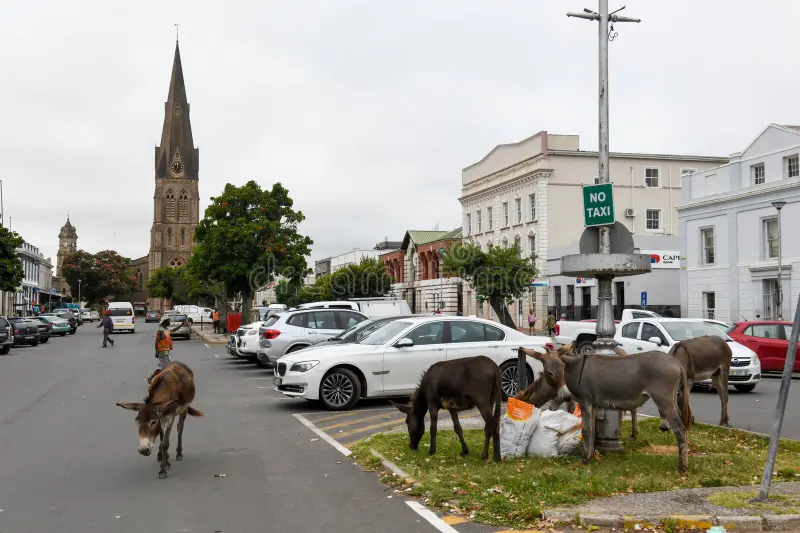
Located in the Eastern Cape, Makhanda is home to some of South Africa’s top-rated schools, including St Andrew’s Prep, St Andrew’s College, the Diocesan School for Girls, and Kingswood College. It is also the home of Rhodes University, which accommodates roughly 9,000 students and dominates the western half of the relatively small town. Despite its prestigious standing as one of South Africa’s top education hubs, the town itself has fallen into disrepair, with dilapidated buildings, pothole-littered roads, and animals roaming the streets.
Residents have complained about a lack of basic services, including water, electricity, and waste removal.The town has experienced frequent water outages since 2012.
Rubbish often piles in the streets, robots are broken, and animals like stray dogs, cows and donkeys wander through town, defecating on the sidewalks and obstructing traffic.The roads are equally bad, with residents often joking that Makhanda is the pothole capital of the country. A few of the roads are so poorly maintained that people find it easier to walk than to navigate the potholes in a car.
The issues have become so well known that one entrepreneur opened a restaurant called the Pothole & Donkey on High Street to poke fun at the state of the city.
Makhanda’s problems have had a severe impact on its visitor numbers. It hosts the National Arts Festival every year, but attendance and revenue have sharply declined over the last decade.The festival generated R460 million in revenue in 2013, which dropped to around R132 million a decade later.
The SAHRC has flagged three material irregularities since 2019. The Makana municipality’s annual financial statements have also received a “poor” rating due to a lack of supporting documents. Severe mismanagement in MakhandMakhanda’s poor service delivery has become a focal point for discussions about governance in the Eastern Cape.There have been calls for the dissolution of the Makana Municipal Council, and in an investigative report into Makhanda’s water and sanitation crisis, the SAHRC said city’s water issues were a systemic human rights violation.